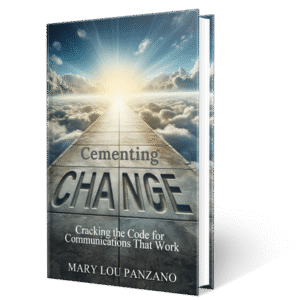
Most people I work with don’t lack the ingredients for change—they were just never given the recipe.
I like recipes because they are predictable. If you use the listed ingredients and follow the instructions, you will have a dish that’s delish. Every. Time.
Career transitions could be handled the same way. But most people I work with – professional women – were never given a recipe. I know I wasn’t.
More than once during my 40+ corporate career with large global companies, I learned that my job was eliminated. The first time that happened, I was lost. I had been with the same company for 22 years at that point. While I moved through various roles within the company, that was the first time I would be searching in the external job market.

I was scared. I was anxious.
I mean, I had never NOT had a job before! I felt a pit in my stomach worrying about how and whether I would find another job.
There was financial stress and family concerns, and, frankly, my confidence waned.
What if I couldn’t find another job near home that I liked, that paid well, had good benefits, and that would enable me to draw on my experience?
It took a few months and a lot of work for me to land my next role. Then, within 3 months of joining, the company went from a start-up to a divestiture! Another job search lay ahead.
Suffice it to say, I know a thing or two about career transitions.
Over time, I began to see a pattern in how people move through change. I now have deep expertise in this area, particularly in communicating effectively as leaders navigate organizational transformations.

What I’m finding today in my conversations with clients is that many of them are dealing with career transitions, and my 4C’s Change Framework™ is helping them navigate them successfully. So, what is that framework, and how can it help professionals going through this?
Let’s start with you. If you’re thinking about a career change right now, you’re not alone.
Something no longer fits. Maybe you’ve outgrown your role. Maybe you want more—but aren’t sure what “more” looks like. Maybe your company made the decision for you. Or maybe, quietly and persistently, you’re no longer willing to settle.
Here’s what I want you to know: You are not starting over. You are moving forward. But forward only works when you have direction.
Why Career Change Feels So Hard (Even for Smart, Capable Professionals)
Most people assume they’re stuck because they don’t have the right strategy. That’s rarely the issue. The real reason? Your brain is wired to resist change.
- It prefers predictability over possibility
- It fears loss more than it values gain
- It avoids the extra energy required to do something new
So even when you know you want something different. You hesitate. You overthink. You second-guess. You wait. Not because you’re incapable—but because you’re human.
The Missing Piece: You Know What You Want … But Don’t Have the Recipe
In my work with leaders and professionals navigating change, I’ve noticed something: Most people already have what they need to move forward. They just don’t know how to use it.
It’s like baking a cake. You can have all the ingredients sitting on the counter—flour, eggs, sugar—but nothing happens until you follow the right process. Changing jobs works the same way. That’s where the 4Cs Change Framework™ comes in.
The 4Cs of Career Transition
These are the ingredients that create momentum and progress:
CLARITY – Knowing what you want next. Not what you should want. Not what looks good on paper. What actually energizes you and why that’s important to you. Ask yourself:
• What do I no longer want?
• What does “better” look like for me now?

CONNECTION – Engaging the right people. You are not meant to figure this out alone. Opportunities come through conversations, not just applications. Ask yourself:
• Who already supports me?
• Who do I need to reconnect with—or meet?
CARING – Honoring your value and experience. This is where many women, in particular, get stuck. You discount your experience. You question your readiness. You discount your value. Instead, ask:
• Where am I underestimating myself?
• What evidence proves I’m more capable than I think?
COURAGE – Taking action despite uncertainty. Clarity, connection, and caring don’t matter if you don’t act. And action will feel uncomfortable. That’s the point. Ask yourself:
• What am I avoiding?
• What’s the cost of staying where I am?
Small Daily Actions Create Big Momentum
Here’s the part most people skip—and why they stay stuck. They think they need a perfect plan before they begin. You don’t. You need consistent movement.
• 10 minutes a day getting clear on what you want
• One outreach conversation
• One reminder of your strengths
• One uncomfortable but aligned action
That’s how change actually happens. Not all at once—but step by step. Like a recipe!
You Don’t Need to Have It All Figured Out
You just need to start. Because clarity comes from action—not the other way around. And when you combine the right ingredients with the right process, something powerful happens: You don’t just survive transition—you design your next chapter.
Ready to take your first step? If this resonated with you, the next step is simple: Book a Career Transition Support Call today.

We’ll start by assessing where you are right now. Where do you already have strength—Clarity, Connection, Confidence, or Courage? And where do you need support? From there, you can begin building your path forward—one aligned step at a time.
When these four elements are in motion, career transition stops feeling like uncertainty—and starts becoming a structured process you can actually move through.
To your prosperity!

 Ready to supercharge your results and rewrite your story? Dive into this dynamic chapter, where uncertainty at the airport becomes a powerful metaphor for navigating change in life and business.
 In today’s relentless world of shifting priorities and constant disruption, most organizations stumble when faced with change. Failed transformation efforts cost millions, erode trust, and leave teams overwhelmed, burnt out, and searching for answers. Why do so many change initiatives unravel, even as the stakes climb ever higher? What hidden forces sabotage progress in the shadows of the workplace?